
Day First of Navratri : Importance, Goddess Worship & Rituals for Maximum Benefits
Navratri is one of the most auspicious festivals in the Hindu calendar, a time when devotion, dance, fasting, melody, and spiritual awakening all come together. Day first of Navratri on 22 September 2025 marks the beginning of nine nights that honor the Divine Feminine in her many forms. This day is especially powerful for setting intentions, aligning energies, and opening pathways for wealth, health, protection, and spiritual growth.
In this comprehensive guide, we’ll explore:
The importance of the first day of Navratri
Which Goddess is worshiped on this day
Rituals and practices to maximize benefits
Vastu-friendly tips, mantras, and more
FAQs with precise answers & spiritual evidence
Table of Contents
What is Navratri & Why the First Day Matters
Date & Muhurta: When to Begin on 22 September 2025
Goddess to Be Worshiped on Day 1 & Her Significance
Rituals & Practices for Benefits: What to Do
Mantras, Yantras & Offerings for Day One
Vastu Tips & Placement of Icons on the First Day
Spiritual, Health, Wealth Benefits of Observing Day One Properly
Common Mistakes to Avoid on Day First
FAQ – Frequently Asked Questions
Conclusion
1. What is Navratri & Why the First Day Matters
Navratri (from Sanskrit nava = nine, ratri = nights) is a nine-night festival dedicated to the Divine Goddess. Depending on region and tradition, different forms of the Goddess (Shakti, Durga, Parvati, etc.) are worshiped. The first day is foundational—think of it as laying the base of a spiritual edifice; what you do today influences the entire nine-night journey.
It is the beginning of spiritual energy: the seed of devotion is planted.
The first day is believed to remove initial obstacles, especially those related to health, finances, or negative energies.
Setting intentions on day one enhances clarity and strength for the rest of Navratri.
The auspicious energy is at its purest: many rituals and mantras are most potent on the opening day.
2. Date & Muhurta: When to Begin on 22 September 2025
Date: 22 September 2025 (Monday) marks the first day (Pratipada) of Shardiya Navratri according to the widely followed lunar calendar.
Muhurta (Auspicious Time): It is important to begin puja after Pratipada Tithi sets in, during Muhurat which astrologically favors the Goddess worship. Usually, this would be in the early morning sunrise hours or during Brahma Muhurta if possible. (Local calculations will vary, so check your city’s Panchang or local temple timings.)
3. Goddess to Be Worshiped on Day 1 & Her Significance
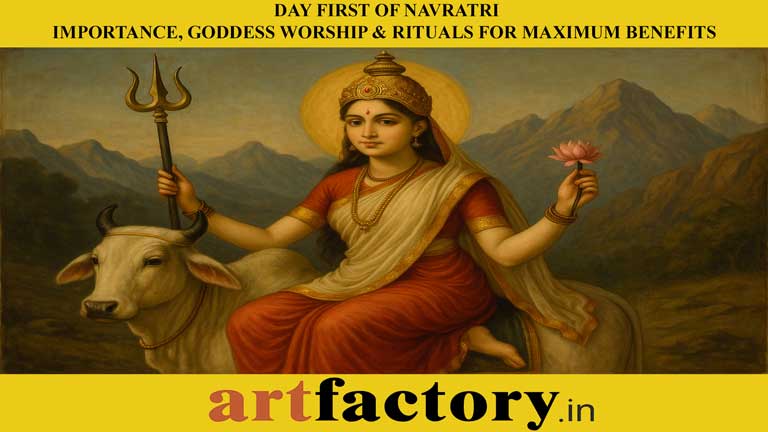
On Day One, the Goddess Shailaputri (also called Parvati in her form as Daughter of the Mountain) is worshiped.
Meaning of Shailaputri: Daughter of the Mountain (Shaila = mountain, Putri = daughter). She represents steadfastness, grounding energy, and the very first manifestation of Shakti after Shiva and Shakti unite.
Symbolism: She carries a trident (Trishul) in one hand and a lotus in the other. She is calm, composed, and signals beginning, strength, and purity.
Why worship her first: Because she sets the foundation — like the root of a tree. Without strong roots, a tree cannot grow. Similarly, Shailaputri strengthens faith, courage, and stability for the remaining days.
4. Rituals & Practices for Benefits: What to Do
Here are time-tested rituals and practices you should perform on 22 September 2025, Day First, to receive maximum benefits:
4.1 Cleanse & Purify the Home
Deep cleaning (physical and energetic) of your home especially North-East (Ishan) and East directions.
Light incense or rice sprinkled around entrance, doors, windows.
Use Vastu-approved cleansers like camphor, ghee lamp smoke, or natural dhoop to remove negative energy.
4.2 Early Morning Sunrise Puja
Wake up early (Brahma Muhurta if possible) before sunrise.
Take bath, wear clean clothes (preferably light or bright colors – yellow/golden/red).
Face East or North-East during puja.
4.3 Idol/Image of Goddess Shailaputri
Place a murt i / image of Shailaputri in your puja altar.
If you have Navratri face-masks or icons, the first Goddess’s face should be visible (Shailaputri).
Use a red or yellow cloth as a base (red is very auspicious).
4.4 Offerings (Prasad) & Flowers
Offer fresh flowers: specifically lotus, red hibiscus, yellow marigold.
Prasad: fruits (especially banana, pomegranate), sweets (like kheer, ladoo), and water.
Also offer Dhatura leaves or BelPatra if tradition allows (since many Durga forms accept these).
4.5 Fasting or Dietary Discipline
Many observe a partial fast, eating only once a day, or consuming fruits, milk, and light food avoiding onions, garlic, meat.
Drinking water infused with Tulsi and mixing in a small pinch of turmeric gives purification benefits.
4.6 Mantra & Meditation
Recite Shailaputri’s mantra: Om Devi Shailaputryai Namah (108 times if possible).
Meditate on her form: imagine steadiness like a mountain, peace, support.
Chant Durga Chalisa / Devi Mahatmyam during the morning or evening.
4.7 Lighting Diyas & Lamps
Light a deepak (lamp) with ghee or sesame oil in the puja room facing East or North-East.
Use 9 wicks (Nava Deep) if possible, or at least one bright lamp.
4.8 Charity & Giving
Donate to the needy: clothes, food, milk, grains – especially in the morning.
Feeding cows, birds, Brahmins etc. brings blessings and positive karma.
5. Mantras, Yantras & Offerings for Day One
| Practice | How to Use | Spiritual Significance |
|---|---|---|
| Mantra of Shailaputri | Chant Om Devi Shailaputryai Namah 108 or 21 times | Invokes strength, courage, removes internal fear |
| Gayatri Mantra / Durga Gayatri | Early morning chanting during Brahma Muhurta | Enhances mental clarity, removes ignorance |
| Yantra Installation | If available, place a Shakti yantra or Navratri yantra under the idol | Focuses energy, attracts prosperity |
| Offerings | Flowers, Durva grass, red cloth, fresh fruits | Symbolizes purity, love, devotion |
6. Vastu Tips & Placement of Icons on the First Day
As a Vastu consultant, I recommend integrating directional energy to strengthen Navratri’s blessings:
Place the Goddess idol or image on the East wall of your puja room or home altar for maximum benefit of sunrise energy.
If East isn’t possible, Northeast (Ishan) is highly auspicious—connects heaven and earth.
Avoid placing idols facing West or South; energy dissipates.
Use of red cloth backing behind the idol boosts fire element energy (Agni), which is very appropriate for Durga/Shakti worship.
Lamps or diyas should be lit on the East or Northeast side of the altar.
Avoid clutter in the puja area—keep space clean, serene, minimal distractions.
7. Spiritual, Health, Wealth Benefits of Observing Day One Properly
When the first day of Navratri is observed with devotion, ritual, and correct intent, the worshiper can experience:
Spiritual Upliftment: Strong alignment with inner strength and courage; reduction of fear, mental blocks.
Emotional Balance: Clarity of mind, peace, reduced anxiety.
Health Benefits: Fasting and clean food help detox; meditative practices reduce stress.
Wealth & Prosperity: Intentions set on Day One draw abundance, remove financial obstacles, attract opportunities.
Protection: From negative energies; Shailaputri’s worship is believed to establish a protective shield.
Fulfilment of Desires: Whether career goals, relationship harmony, or achieving spiritual milestones.
8. Common Mistakes to Avoid on Day First
Starting puja in incorrect Tithi or before the auspicious Muhurta.
Using stale or withered flowers.
Having dirty or cluttered puja space.
Speaking harshly or harboring anger—negates purity.
Eating non-sattvic food if observing fast.
Placing the idol on an inappropriate direction (e.g. facing West inward) or on floor rather than altar/table.
9. FAQ – Frequently Asked Questions
Here are precise Q&A’s about the first day of Navratri, with evidence and clarity.
Q1: Why is Shailaputri worshiped on the first day of Navratri?
Answer: Shailaputri is the first form of the Divine Mother in the sequence of Navadurga. Worshiping her first is like planting a seed—she provides the grounding, courage, and purity needed for the other forms (Brahmacharini, Chandraghanta etc.). Traditional scriptures like Durga Saptashati describe her as steadfast and the root from which all forms arise.
Evidence: Vedic and Puranic texts (e.g. Devi Mahatmya) enumerate her as the first day’s Goddess, assigning her the Tamas-Raja balance, and describing her iconography as carrying a trident and lotus.
Q2: Is fasting compulsory on Day One of Navratri?
Answer: Fasting is highly meritorious but not compulsory. The degree of fasting (complete fast, partial fast, or simple diet restrictions) depends on individual capability, health, and tradition. The focus should be on devotion, purification of mind and body.
Evidence: Many Navratri traditions mention that even if one fasts only part of the day or eats sattvic food, the spiritual rewards are accepted by the Goddess.
Q3: What is the right time (Muhurta) to begin worship on 22 September 2025?
Answer: The correct Muhurta depends on local sunrise, Tithi beginning, and Brahma Muhurta. Generally, one should begin after the Pratipada Tithi has commenced, often early morning. Many astrologers and local temples will publish timing.
Evidence: Hindu Panchangams state the Tithi beginning, and traditional Vedic practice emphasizes starting rituals in Brahma Muhurta for purity and strength of mantras.
Q4: Can non-Hindus or people unfamiliar with rituals also observe Day One?
Answer: Yes. The essence is intention, purity of heart, and respect. Even simple practices—lighting a lamp, chanting a mantra, offering flowers—work beautifully. One need not have elaborate setup.
Evidence: Across various communities, devotional sincerity matters more than grandeur. Many spiritual teachers emphasize Bhakti (devotion) over ritual perfection.
Q5: What are the spiritual consequences of missing Day One of Navratri?
Answer: Traditional belief says that missing the first day could mean that some of the foundational blessings—like strength, protection, removal of obstacles—might be delayed or reduced. But with sincere repentance, any missed day can be compensated by extra devotion or giving.
Evidence: Stotras and stories of devotees often show that sincere efforts—even if imperfect—are accepted by the Goddess; many perform special Sahasranama or recite more mantras to cover misses.
10. Conclusion
The first day of Navratri on 22 September 2025 is not just the start of a festival—it is the opening of spiritual doors. Honoring Goddess Shailaputri with purity, correct ritual, devotion, and Vastu awareness can lay powerful foundations for the nine nights ahead. Whether your aim is spiritual growth, protection, wealth, or emotional peace, the practices described will help you align with the Divine Feminine and receive her blessings.
Embrace the rituals, light the lamp of devotion, anchor your intentions, and let Day One of Navratri be the strongest pillar of your nine-night spiritual journey.
Comments : (0)